
Family-owned wet pet food manufacturing in Northern Ireland since 1972
+44 (0) 28 8778 4641
Family-owned wet pet food manufacturing in Northern Ireland since 1972
+44 (0) 28 8778 4641
Direct-from-factory pet food solutions engineered for retail chains, brand owners, and global distributors. All products are manufactured under strict HACCP and ISO22000 biosecurity protocols.
Understanding structural shifts in global pet food supply chains and how Chinese OEM/ODM factories are driving innovation in high-protein, clean-label feline diets.
The global pet food sector is undergoing a profound structural evolution. Historically dominated by Western European and North American processing hubs, international brand owners and retail giants are increasingly consolidating their private label production in top-tier Chinese manufacturing centers. This movement is powered by massive capital investments in automated retort processing, state-of-the-art freeze-drying infrastructure (FD), and direct integration with sustainable marine and poultry raw material supply chains.
Modern pet food procurement managers require far more than basic price-per-ton metrics. Search Intent and Search Quality Rater Guidelines (E-E-A-T) dictate that real competitive advantage stems from verified operational capabilities: thermal processing validation, moisture activity ($a_w$) control, biological safety protocols, and transparent ingredient sourcing. Chinese premier suppliers now operate under international standards matching European FEDIAF and US AAFCO nutritional profiles.
Strategic Sourcing Note: Leading Chinese cat food factories now feature fully enclosed, clean-room processing facilities certified under BRCGS Food Safety Standard (Issue 9), IFS Food, and ISO 22000. This structural maturity enables international importers to secure high-margin, shelf-stable wet food, lickable purees, and freeze-dried treats with complete regulatory safety.
| Cat Food Format Category | Primary Processing Technology | Key Analytical Benchmark | Target Shelf-Life | Primary B2B Packaging Format |
|---|---|---|---|---|
| Lickable Purees & Creamy Strips | Thermal Emulsification & Pouch Retort | Crude Protein ≥ 6.5%, Moisture ≤ 88% | 24 Months | 14g - 15g Multi-layer Barrier Foil Sticks |
| Freeze-Dried Pure Meat / Treats | Sublimation Vacuum Freeze-Drying (-40°C) | Crude Protein ≥ 60%, Moisture ≤ 6% | 18 - 24 Months | Nitrogen-Flushed Pouch / Clear Jars |
| Wet Canned Cat Food (Pâté / Chunks) | High-Pressure Steam Retort Sterilisation | Crude Protein ≥ 10%, Moisture ≤ 82% | 36 Months | 85g / 170g / 400g Easy-Open Aluminum/Tin Cans |
| High-Protein Extruded Dry Kibble | Twin-Screw Thermal Extrusion + Vacuum Coating | Crude Protein ≥ 38% - 45%, Fat ≥ 16% | 18 Months | Resealable Zipper Bags (1.5kg - 10kg) |
Cats are obligate carnivores. Modern pet humanization has shifted purchasing criteria toward high-animal-protein, grain-free, and functional wellness formulations.
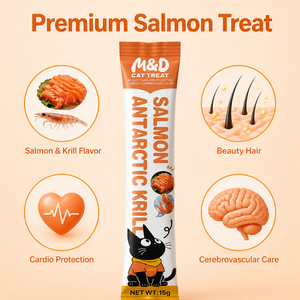
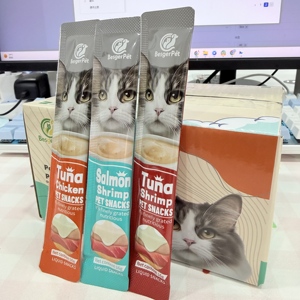
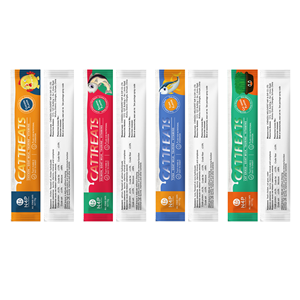
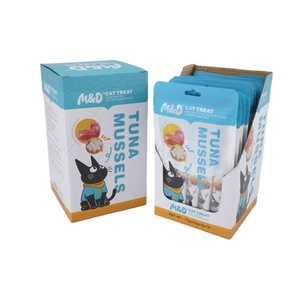
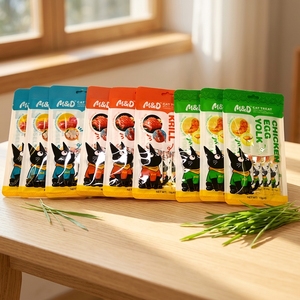
Squeezable wet treats have transitioned from niche snacks to essential daily interactive feeding rituals. Formulated with high-grade wild tuna, deep-sea salmon, and fresh chicken breast, these products offer moisture hydration essential for feline kidney health while maintaining zero artificial binders, grain, or carrageenan.
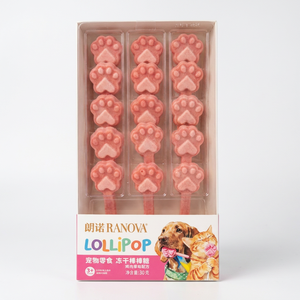
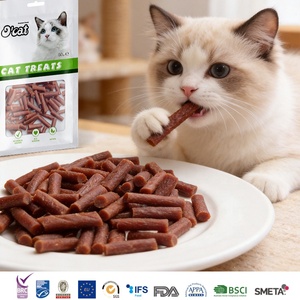
Freeze-dried raw meat cubes, paw-shaped lollipops, and reconstituted topper treats represent the fastest-growing segment in premium cat retail. By freezing fresh meat at -40°C and sublimating ice directly to vapor, factories preserve volatile nutrients, original amino acid structures, and natural palatability without high heat degradation.
B2B buyers are demanding functional additive matrices in private label lines. Modern formulations integrate prebiotic dietary fibers (FOS/MOS) for gastrointestinal balance, Omega-3 EPA/DHA fatty acids for coat skin vitality, taurine for cardiac/retinal support, and cranberry extract for urinary tract care.
Examining the technical capabilities, single-site accountability, and rigorous food safety systems that differentiate premier manufacturing partners.
The highest standard of pet food safety is achieved through unified site execution. Superior Chinese factories control the entire processing flow under one roof: from cold-chain raw material intake and micro-ingredient dosing to continuous thermal cooking, high-speed automated pouch filling, retort sterilisation, and robotized end-of-line packaging.
This single-site accountability eliminates cross-contamination risks associated with outsourced processing steps and guarantees complete batch-level traceability from raw supply to export container loading.
All wet pouch and canned lines undergo high-pressure retort sterilization operating at precise thermal parameters ($F_0 \ge 3.0$) to guarantee commercial sterility against Clostridium botulinum and other heat-resistant microbial pathogens.
Key macro-economic and technological shifts that procurement directors must evaluate when establishing long-term pet food contract manufacturing agreements.
Global logistics bottlenecks have elevated the importance of factory location. Modern Chinese mega-factories situated near deep-water export ports (such as Qingdao, Ningbo, and Shanghai) provide strategic freight flexibility. Integrated container loading, rapid export customs documentation (CIQ health certificates), and direct shipping lines ensure stable landed costs across European, North American, and Middle Eastern markets.
Environmental regulations and consumer expectations are pushing the industry away from traditional multi-layer aluminum foils. Advanced factories are transitioning to recyclable mono-PP barrier pouches and light-weight aluminum cans that withstand 121°C retort conditions without compromising shelf-life stability or barrier protection against oxygen and moisture transmission ($OTR / WVTR$).
As pet food buyers face increased competition, product differentiation depends on custom formulation capability. Chinese OEM partners are leading the integration of novel protein sources—including hydrolysed salmon proteins, Antarctic krill meal, duck liver, and insect-derived proteins—engineered to reduce feline food sensitivity while maximizing protein digestibility scores.
Regulatory compliance is no longer an afterthought. Premier suppliers maintain active registration with the US FDA (Food Facility Registration), EU TRACES system, GACC (General Administration of Customs of China), and regional agricultural departments. This ensures that every container exported passes destination quarantine inspections smoothly without risk of port rejection.
Clear, authoritative answers to the most critical technical, commercial, and operational questions asked by international pet food buyers.
MOQs depend heavily on the packaging format. For squeezable lickable treat pouches (14g–15g stick packs), standard production runs typically start at 100,000 to 200,000 sticks per flavor due to automated film printing setup requirements. For canned wet food (85g/400g), MOQs generally start at 30,000 cans. Freeze-dried products offer lower MOQs, often starting at 500 kg per batch.
Leading factories employ full-time animal nutritionists and collaborate with independent veterinary institutes. Formulations are cross-checked against AAFCO and FEDIAF nutrient profiles for specific life stages (Kitten, Adult Maintenance, All Life Stages). Every batch undergoes proximate analysis (Crude Protein, Crude Fat, Crude Fiber, Ash, Moisture, Calcium, Phosphorus, Taurine) prior to certificate of analysis (COA) issuance.
A standard private label development pipeline spans 12 to 18 weeks. This timeframe includes initial formulation alignment (Week 1–2), benchtop sample preparation and palatability testing (Week 3–5), packaging artwork layout and custom cylinder printing (Week 6–9), factory trial run and shelf-life validation (Week 10–12), and commercial mass production with export customs clearance (Week 13–18).
Biosecurity is controlled through rigorous HACCP pre-requisite programs. Raw meat intake undergoes strict temperature monitoring (<4°C for chilled, <-18°C for frozen). Wet pouch and canned products undergo thermal processing in computer-controlled retorts operating at 121.1°C under pressure. Finished goods are subject to a mandatory 14-day hold protocol with micro-testing for Salmonella, E. coli, and Listeria before dispatch.
Yes. OEM/ODM research and development teams specialize in reverse engineering and benchmark formulation. Importers can submit a target market sample; the laboratory performs nutrient analysis, texture profile analysis (TPA), and palatability trials to replicate or surpass the target profile while optimizing cost-in-use parameters.
Factories provide a comprehensive export paperwork package including: Official Health/Veterinary Certificate issued by GACC/CIQ, Certificate of Origin (Form E, CO, etc.), Certificate of Analysis (COA), Ingredient Declaration, Process Flowchart, Free Sale Certificate, and detailed Packing Lists with Container Sealing verification.