Family-owned wet pet food manufacturing in Northern Ireland since 1972
+44 (0) 28 8778 4641
China’s natural pet food sector has grown from small specialty workshops into a diverse manufacturing network. This guide introduces leading Chinese suppliers involved in Natural Pet Food Manufacturing. It focuses on practical evidence, not attractive claims alone. Buyers should examine ingredient origins, processing controls, export experience, and product consistency.
A reliable manufacturer should explain where its chicken, fish, grains, vegetables, and supplements come from. Factory visits can reveal important details, including clean storage rooms, temperature records, sealed packaging lines, and visible batch identification. Independent laboratory testing also matters. Tests may cover microbial safety, heavy metals, pesticide residues, and nutritional accuracy. Certifications can support trust, but they should be verified against current production sites and product categories.
The strongest manufacturers usually offer formulation support, private-label services, stable capacity, and clear documentation. However, “top” is not an absolute label. A large factory may not suit a small premium brand, while a smaller producer may provide closer communication and greater flexibility. This is where many comparisons become imperfect. Marketing language sometimes hides limited sourcing transparency or inconsistent quality between batches.
This overview will compare manufacturers through measurable criteria, including facility capability, quality assurance, product development, packaging options, and international cooperation. It will also consider how suppliers respond when problems occur. Honest communication matters. A dependable partner should provide corrective actions, updated test reports, and realistic delivery schedules. These details help buyers make safer, better-informed decisions in China’s expanding natural pet food market.
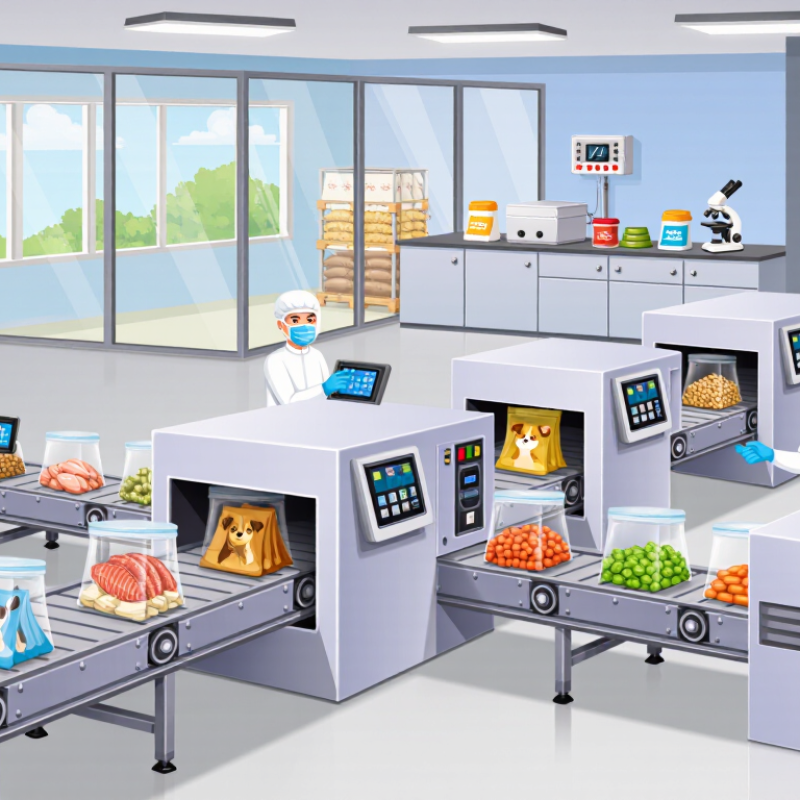
Natural pet food manufacturing in China covers the sourcing, processing, testing, and packing of pet food made with recognizable ingredients. The term “natural” has no single global meaning. Its interpretation can vary by market, product type, and labeling rules.
In practice, manufacturers may use meat, fish, vegetables, grains, oils, and selected vitamins. They should document each ingredient’s origin and specifications. Factory teams commonly review supplier records, certificates of analysis, and incoming material samples. They also monitor moisture, protein, oxidation, and microbiological indicators. Small details matter. A damaged storage bag can affect an entire batch.
The scope extends beyond recipes. It includes controlled cooking temperatures, allergen separation, sanitation, traceability, packaging, and warehouse conditions. Good facilities retain batch records from raw material receipt to shipment. Independent testing can support quality claims, but one test cannot prove everything. This is where the industry still needs reflection. “Natural” does not automatically mean nutritionally complete, environmentally responsible, or suitable for every pet.
Manufacturers serving international buyers must also evaluate destination-market requirements. These may involve ingredient declarations, feeding instructions, safety documentation, and packaging language. Experienced buyers often request factory audits and sample production before larger orders. That process can reveal practical weaknesses, such as inconsistent kibble size or unclear lot coding. Reliable manufacturing depends on evidence, repeatable controls, and honest communication rather than attractive wording alone.
China’s natural pet food sector deserves careful, evidence-based supplier screening. The 2023–2024 China Pet Industry White Paper reported an urban dog-and-cat market of approximately RMB 279.3 billion, increasing pressure on manufacturers to prove quality claims. “Natural” is not a universal legal standard. Ask for a precise definition, ingredient specifications, and claim substantiation.
Factory hygiene is only the beginning. Verify HACCP or ISO 22000 systems, production licenses, allergen controls, and documented supplier approval. Request batch-level certificates of analysis for protein, moisture, ash, mycotoxins, heavy metals, and microbial limits. The testing laboratory should hold recognized accreditation, such as ISO/IEC 17025. Traceability should work backward from a finished pouch to each raw-material lot. Test it.
Nutrition deserves equal attention. Compare formulations with AAFCO or FEDIAF nutritional guidance, while checking whether feeding trials or digestibility studies support the product’s life-stage claims. Euromonitor International’s Pet Care in China 2024 highlights continued premiumization, but premium pricing does not prove nutritional superiority. A transparent manufacturer should explain protein sources, processing temperatures, preservative choices, and shelf-life validation.
A factory visit can still mislead. Clean floors do not guarantee stable formulation control. Some audit records may look complete yet lack independent verification. Recheck results across several batches, not one impressive sample. Also assess recall procedures, complaint handling, export experience, and labeling accuracy for the destination market. The strongest Chinese manufacturer is not merely modern; it is consistently measurable, transparent, and willing to disclose weaknesses.
China Top Natural Pet Food Manufacturers?
China’s leading natural pet food manufacturers increasingly organize products by animal need, ingredient profile, and life stage. Their main categories include grain-free dry food, gently cooked meals, freeze-dried meat, wet food, dental treats, and functional supplements. Common functional formulas target digestion, skin, joints, weight control, or urinary health. Product developers often use poultry, fish, beef, pumpkin, sweet potato, or seaweed. However, “natural” has no single global legal definition. That label is not always precise.
Industry data supports this shift. The American Pet Products Association reported US$65.8 billion in pet food and treat sales for 2024. Grand View Research also identifies premium and natural nutrition as major growth areas in the global pet food market. These figures do not measure China alone, but they show stronger demand for traceable ingredients and specialized diets. Experienced buyers should review factory audits, ingredient certificates, microbial testing, and feeding-trial evidence. Packaging claims alone are weak evidence.
Tips: Ask manufacturers for a complete product specification, not only a brochure. Check protein sources, moisture levels, calories, and additive functions. Confirm whether freeze-dried products are complete diets or supplemental treats. A useful factory should explain batch control clearly. It should also admit product limits. I would question any supplier promising universal health benefits, because nutrition results vary by breed, age, activity, and medical history.
China Top Natural Pet Food Manufacturers?
Production quality matters more than the word “natural.” AAFCO defines natural ingredients narrowly, but global definitions still vary. Buyers should request a complete ingredient specification, processing flow, and allergen statement. FEDIAF’s 2024 Facts and Figures report estimates 139 million European households own pets. That scale makes reliable traceability essential, not optional.
Strong Chinese manufacturers normally operate documented HACCP systems and may hold ISO 22000, FSSC 22000, BRCGS, or IFS certification. Certifications help, but they are not proof of every batch. Check the certificate scope, issuing body, audit date, and covered factory. Under FDA 21 CFR Part 507, food facilities need preventive controls, sanitation procedures, and hazard analysis. Practical controls should include supplier approval, incoming-material testing, pathogen screening, mycotoxin checks, heavy-metal analysis, nutritional testing, and retained samples. Records matter. A certificate can be outdated. That is an uncomfortable but important weakness.
Tips: Ask for recent laboratory reports, batch traceability records, recall procedures, and environmental monitoring results. Verify whether testing uses an independent laboratory. Inspect sample packaging for lot codes, seal integrity, and storage instructions. Compare the guaranteed analysis with laboratory results, because label values may not reflect real variation. Also check how the manufacturer manages moisture, oxidation, and cross-contact during production. “Natural” sounds reassuring, yet process discipline decides safety. One missing record can reveal a larger control problem.
A manufacturer-neutral comparison framework for evaluating natural pet food production in China. Requirements and certification claims should be verified against the current factory documents and product scope.
| Evaluation Dimension | Relevant Standard, Certification, or Control Framework | What It Covers | Typical Quality-Control Evidence | Relevance to Natural Pet Food | Verification Status |
|---|---|---|---|---|---|
| Chinese Pet Feed Compliance | China's pet feed regulatory framework, including the Administrative Measures for Pet Feed, Pet Feed Labeling Provisions, and Pet Feed Hygiene Provisions | Product registration or filing requirements where applicable, labeling, permitted claims, hygiene controls, and market compliance | Product formula records, regulatory filing documents where required, approved labels, production records, and inspection reports | Helps confirm that “natural,” functional, nutritional, and ingredient-related claims are presented within applicable Chinese requirements | Mandatory where applicable |
| Product Nutrition and Category | Relevant Chinese pet food standards, including GB/T 31216 for dog food and GB/T 31217 for cat food, where applicable to the product category | Product classification, nutritional specifications, testing requirements, and terminology for complete pet food products | Formula specifications, nutrient calculations, laboratory test results, feeding directions, and finished-product release records | Supports consistency in complete-food formulas marketed as natural, grain-free, limited-ingredient, or high-meat products | Product-specific |
| Feed Hygiene and Contaminant Control | GB 13078, Feed Hygiene Standard, together with applicable limits for contaminants and undesirable substances | Control of microbiological hazards, heavy metals, mycotoxins, pesticide residues, and other undesirable substances | Raw-material COAs, supplier approval files, sampling plans, pathogen testing, mycotoxin reports, and corrective-action records | Important for minimally processed recipes because ingredient quality and storage conditions strongly affect safety | Mandatory hygiene basis |
| HACCP-Based Food Safety | HACCP principles based on Codex Alimentarius; often incorporated into ISO 22000, FSSC 22000, or customer audit programs | Hazard analysis, critical control points, preventive controls, monitoring, verification, and corrective actions | HACCP plan, hazard analysis, CCP monitoring logs, deviation reports, verification results, and management review records | Provides a structured method for controlling biological, chemical, and physical hazards throughout production | Widely expected |
| ISO 22000 Food Safety Management | ISO 22000:2018 | Food safety management systems, prerequisite programs, communication, risk management, and continual improvement | Valid certificate, certification scope, audit reports, internal-audit records, training files, and management-review minutes | Useful for assessing whether food-safety controls are managed as a documented system rather than as isolated tests | Voluntary certification |
| FSSC 22000 | FSSC 22000 certification scheme, based on ISO 22000, sector prerequisite programs, and additional scheme requirements | Audited food safety management, prerequisite programs, food defense, food fraud prevention, environmental monitoring, and continual improvement | Certificate number, scope statement, audit status, food-defense plan, food-fraud vulnerability assessment, and environmental monitoring records | Can provide stronger third-party system assurance for export-oriented or large-scale production facilities | Voluntary certification |
| BRCGS Food Safety | BRCGS Global Standard Food Safety, when the factory holds a valid certification within the relevant scope | Site standards, product safety, process control, personnel hygiene, traceability, allergen management, and supplier controls | Current certificate, grade, audit date, scope, traceability exercise, sanitation records, and nonconformity close-out documents | Often valued by international retailers and importers requiring detailed site and process audits | Customer or market dependent |
| Ingredient Supplier Approval | Documented supplier-qualification procedure aligned with HACCP or a certified food-safety management system | Approval, risk ranking, incoming specifications, change notification, supplier performance, and periodic reassessment | Supplier questionnaires, audits, COAs, sample approvals, purchase specifications, and supplier corrective-action records | Particularly important for meat, fish, oils, botanical ingredients, probiotics, and functional additives used in natural formulas | Core best practice |
| Traceability and Recall Readiness | One-step-back and one-step-forward traceability practices; recall procedures required by the applicable management system and market | Linkage between suppliers, production batches, packaging materials, finished goods, warehouses, and customers | Batch codes, ERP or paper records, mock-recall results, distribution lists, retention samples, and recall-response procedures | Allows rapid identification of affected lots if an ingredient, packaging component, or process deviation is later questioned | Essential control |
| Microbiological Testing | Validated internal or third-party laboratory methods for pathogens and indicator organisms | Salmonella, Enterobacteriaceae, total plate count, yeast and mold, and other tests selected by product risk | Sampling plans, laboratory accreditation details, test reports, environmental swabs, sanitation verification, and trend analysis | Critical for raw or gently processed materials and for products containing animal-derived ingredients | Risk-based testing |
| Chemical and Nutritional Verification | Approved laboratory methods and applicable Chinese or destination-market specifications | Protein, fat, moisture, ash, fiber, calcium, phosphorus, vitamins, minerals, preservatives, and selected contaminants | Finished-product COAs, laboratory reports, method references, calibration records, and specification-release checks | Confirms that “high-protein,” “complete,” “limited ingredient,” and similar claims are supported by measurable results | Required by specification |
| Process Control and Validation | Validated thermal processing, drying, extrusion, retort, freeze-drying, or other process parameters appropriate to the product | Time-temperature control, moisture reduction, water activity, lethality, cooling, metal detection, and process deviations | Batch charts, calibrated instruments, validation studies, water-activity results, metal-detector checks, and deviation investigations | Balances the goal of minimal processing with the need to achieve microbiological safety and shelf stability | Product and process specific |
| Allergen and Cross-Contact Management | Risk-based allergen-control program under the factory's food-safety system | Ingredient identification, segregation, production sequencing, cleaning validation, label review, and change control | Allergen matrix, line-clearance records, sanitation verification, label approvals, and production scheduling records | Important for limited-ingredient, single-protein, hypoallergenic, and sensitive-diet product claims | Claim-dependent |
| Packaging and Shelf-Life | Packaging specifications, migration or compatibility assessments where applicable, and documented shelf-life studies | Barrier performance, seal integrity, oxygen and moisture protection, storage conditions, and expiration-date substantiation | Packaging COAs, seal tests, accelerated or real-time stability data, retained samples, and warehouse-condition records | Supports preservation of fats, aromas, vitamins, and texture in natural products with fewer synthetic preservatives | Required for reliable dating |
| Label and Marketing Claim Review | Chinese pet feed labeling requirements plus destination-market rules for exported products | Ingredient list, guaranteed analysis, feeding instructions, net quantity, manufacturer information, batch identification, and claims | Artwork approval records, formula-to-label checks, translation review, claim substantiation, and change-control approvals | Reduces the risk of unsupported claims such as “human-grade,” “organic,” “free-range,” or “preservative-free” | Mandatory before release |
| Organic or Specialized Claims | Recognized organic certification or destination-market certification, when an organic claim is made | Certified ingredient sourcing, segregation, mass balance, processing controls, and permitted labeling claims | Current certificate, certificate scope, transaction certificates where required, supplier certificates, and segregation records | An organic claim should not be treated as verified unless the finished product and relevant supply chain are covered by a valid certification | Claim-specific verification |
| Factory Hygiene and Pest Control | Good Manufacturing Practice and prerequisite programs supporting HACCP or ISO-based systems | Personnel hygiene, zoning, cleaning, sanitation, water quality, waste handling, pest control, and facility maintenance | Cleaning schedules, sanitation inspections, pest-control maps, maintenance logs, hygiene training, and environmental-monitoring trends | Reduces contamination risk in facilities handling meat meals, fresh meat, oils, grains, herbs, and supplements | Foundational practice |
| Export and Customer-Specific Controls | Destination-market import requirements, customer specifications, and applicable registration requirements | Country-specific labeling, prohibited ingredients, testing, establishment registration, documentation, and shipping controls | Export registration records, destination-market test reports, approved specifications, customs documents, and customer-audit results | Confirms whether a facility can consistently meet the requirements of a particular importing country or retail program | Market dependent |
Practical verification note: A certification is meaningful only when the certificate is current, the legal entity and manufacturing site match, and the product category and production activities fall within the stated scope. Certification schemes, Chinese regulations, and destination-market requirements should be checked against their latest official versions before supplier approval.
China Top Natural Pet Food Manufacturers?
China’s natural pet food sector is moving from contract production toward ingredient-led innovation. APPA reported that U.S. pet industry sales reached approximately $152 billion in 2024. This supports demand for premium nutrition, including limited-ingredient recipes and functional supplements. Euromonitor also identifies pet humanisation as a major global growth driver. Chinese manufacturers can respond with freeze-dried meat, fish-based formulas, and traceable botanical ingredients.
Export buyers now expect more than attractive packaging. They request batch testing, stable moisture levels, allergen controls, and transparent sourcing records. The U.S. FDA and European feed regulations require careful labeling and safety documentation. Digital traceability can show where a chicken meal was processed, not merely where it was packed. This detail builds credibility.
The opportunity is real, but not effortless. Smaller factories may struggle with certification costs and consistent overseas service. Natural claims also need scientific support; “clean” is not a universal legal category. A manufacturer may produce excellent food yet explain it poorly. That gap matters. Chinese suppliers should invest in laboratory partnerships, multilingual technical files, and smaller trial shipments. Buyers often prefer a reliable 500-kilogram test order before committing to containers. The market rewards patience.
China's pet food exports have shown sustained long-term growth. The chart uses China's export value for HS 230910, “dog or cat food, put up for retail sale,” as a measurable proxy for the broader commercial pet food sector. Rising export value indicates expanding overseas demand and opportunities for Chinese manufacturers with natural, functional, organic, and customized product lines.
Source: UN Comtrade trade classification HS 230910; values shown in rounded US$ billions.
Common categories include grain-free dry food, gently cooked meals, freeze-dried meat, wet food, dental treats, and supplements. Some formulas target digestion, skin, joints, weight control, or urinary health.
Manufacturers often use poultry, fish, beef, pumpkin, sweet potato, and seaweed. A clear ingredient list matters more than attractive packaging.
No. The term can vary between countries and product categories. Buyers should check exact definitions, labeling rules, and supporting evidence. The word alone proves little.
Request product specifications, ingredient certificates, microbial test reports, and feeding-trial evidence. Also review factory audits, batch records, allergen controls, and sourcing documents. A brochure is not enough.
Confirm whether it is a complete diet or only a supplemental treat. Check protein sources, moisture levels, calories, and feeding instructions. Ask how the product is tested after processing.
Formulas may support digestion, skin condition, joint mobility, weight management, or urinary health. Results differ by breed, age, activity, and medical history. No formula works for every animal.
Review labeling rules, safety documents, batch testing, moisture stability, and traceability records. A digital record should identify where ingredients were processed, not only packed. Small trial shipments are sensible.
Yes, it can reveal service problems before a container-sized commitment. Check taste acceptance, packaging strength, delivery timing, and batch consistency. This still cannot predict every future issue.
They may struggle with certification costs, consistent production, and multilingual technical support. A factory can make good food yet explain it poorly. That gap deserves attention.
Be cautious about universal health promises or vague “clean” claims. Ask for scientific support, testing details, and product limitations. Honest answers are reassuring.
Natural Pet Food Manufacturing in China covers the development and production of pet foods made with carefully selected ingredients, transparent formulations, and reduced reliance on unnecessary artificial additives. This article explains how to evaluate manufacturers by examining ingredient sourcing, nutritional research, production capacity, traceability, customization services, and consistency in quality. It also introduces major product categories, including dry food, wet food, treats, freeze-dried products, and specialized formulas for different life stages or dietary needs.
The discussion further highlights production standards, facility management, laboratory testing, hygiene controls, and certifications that support product safety and reliability. In addition, it explores current market trends such as premiumization, functional nutrition, sustainable packaging, and demand for clearer ingredient information. With improving manufacturing capabilities and expanding international demand, Chinese pet food producers may find valuable export opportunities by strengthening compliance, documentation, product innovation, and communication with overseas customers.